

- Immersion is not that deep. Just immerse and let your motivation guide you. That's your freedom with immersion. You choose what to read or listen to.
- It's a good idea to make your immersion more reading focused at the beginning. Reading = builds a solid base of the language; makes listening later easier.
- Listening is difficult at the beginning; no solid base of the language (vocab, grammar etc.) and can't properly parse sounds. Listening becomes more training language comprehension than training listening ability; discouraging to pause and look up a lot.
- Focusing only on listening at the beginning will give you great pronunciation and good conversation skills, but you'll be limited by basic vocab and poor reading ability.
- The consequence: You reach a brick wall you can't break through because you lack the rich mental model of the language only reading can provide you.
- Just reading more solves most if not all problems. Reading and Listening are not two separate skills. You could say reading builds the mental model and listening uses that model. Mix both for best results.
Types of immersion
Immersion can be either reading or listening. Some guides further subdivide these into 3 types:
Free Flow
Effortless
Casual Immersion
Balanced
Hardcore Immersion
Intensive
Note: I think it makes sense to mention terminology used by other immersion guides so you can read through these as well if you are interested.
Now, what would you think is the most efficient way for beginners to do immersion at the beginning? Is it doing listening first with a workflow akin to type 2 or maybe reading something first with type 3 or maybe a mix of these or something completely different? I ask you to pause here and think for yourself.
Freedom with immersion

The point I want you to realize is that the confusion on what to immerse in is the freedom you have with immersion. You have this confusion because of the freedom of choice you have with what kind of media you can immersion with. You navigate through this freedom by letting your motivation i.e the fun you are having guide you, without overthinking too much on the method or details. This is because **Immersion is actually not that deep**.
Putting efficiency aside, if you feel like doing listening like watching a show right now, that is also at a comfortable level for you meaning you can stomach it (nearing i+1i+1—One unknown piece of information in a sentence) then go for it, don't let it wait!
If you want to read something right now then go for it. Why not capitalize on where ever your motivation is guiding you at the moment? If something is tedious or not fun then drop it and switch things up and maybe revisit it later if you are still interested. You are basically your own guide.
Someone who is enjoying themselves doing something they are interested in, will naturally have a better experience learning and see more results. This hold true not only for immersion language learning but other skills as well.
This freedom is exactly why immersion is so different and more effective than traditional methods. You decide what you want to immerse in, and to what extend, what to mine and to look up and thus what to learn. If you are interested in a specific domain like architecture, then nobody is forcing you to learn vocab relating to something different like baseball terminology. You decide what you learn and don't learn and you decide your pace as well. If you want to read more today then nobody is stopping, same for listening. If you want to watch one more episode then you can. You decide what you learn and how much you do that. This freedom is the biggest upside and difference between traditional language learning methods and immersion. In school or language class this is most often different, because for one you have to not only immerse in material most often not interesting to you but also learn vocab associated with that material, while doing all of this at a set pace determined by your teacher.
Enjoyment vs. Efficiency
With that being said, nobody can or should be able to judge you for immersing in whats fun for you since you have your own goals and priorities. Immersing by strictly choosing whats interests is not bad, since whatever you find most enjoyable will eventually bring the great results. The question we now should be asking ourselves:
"Do you can justify for yourself choosing this path of strictly doing whats most enjoyable over a more efficient path that gets you to your goal faster but maybe a less enjoyable path?"
Sometimes whats most enjoyable is not the most efficient way to achieve your goals.
A weird analogy
To illustrate that, imagine your mom tells you to go to the grocery store to buy steak. So you go there and on the way you see your favorite chocolate thats on sale, so you decide to stop by and throw it into your shopping basket. Now at the cashier you pay and leave the store. While going back home, eating your newly bought chocolate, you see the kiosk and remember the magazine that you're interested in released a new issue today. So you quickly eat up your chocolate and go into the kiosk to read for a bit before leaving going back home. At home now, you give your mom your steak and she's happy and prepares dinner.
You're mom is probably not going to scold you for spending money and time buying a chocolate and reading some magazine at the kiosk, because she doesn't need the steak right away as fast as possible. But speaking from an efficiency perspective you could have probably bought the chocolate another time or went back home first and then went to read that magazine at the kiosk. With immersion its the same.
You can totally approach immersion however you like. For example, you might want to dive right in by watching your show you have been eyeing; that's your "chocolate and magazine". But here is the catch: If your listening isn't ready for it, that "treat" can quickly become like a frustrating chore, thus maybe "wasting" that treat. Instead of enjoying it, you'll be "gulping down the chocolate" quickly just to get through it, missing the pleasure. What's enjoyable is of course subjective, but starting with material that's too difficult can burn you out and cost you valuable time.
The efficient path isn't always the most fun, but the most fun path often requires a baseline of comprehension to actually be enjoyable. So, choose your starting point wisely, based on what you can sustain, not just on what you're most excited about. → Reference](roadmap.md#trade-of-between-enjoyment-and-efficiency)
Why listening is hard
Generally speaking listening is going to be way harder for beginners than reading because there is an added layer of complexity, like accustoming your ears to properly parse the foreign sounds of your target language in your head and then translating these sounds to words and meaning. With some language like Japanese you are likely to encounter a lot of homonyms (words with the same reading but different meaning depending on context) that just adds more difficulty. As outlined in earlier sections the most efficient way to learn is by following the right ratio of new information and information you are already familiar with. Concretely this means using the context and the parts of a given sentence you already comprehend, ideally 80-85% of a sentence, to infer and learn the missing pieces of information, the remaining 15-20%.
Problematic with listening
The problematic with audio based immersion for beginners is that to upholding this ratio will be hard. As a beginner you naturally will struggle to intuitively and quickly grasp full sentences because you have far too little capability to comprehend anything well in your target language yet. In this case, reading is great because you can easier find reading material targeted at beginners, read at your own pace and take your time looking up words and attempting to piece them together to comprehend a given sentence. Since you are struggling that would be less than 80% so around 50-70% comprehension with 30-50% unknown information i.e struggle learning environment which is still really good for a beginner!
Why listening is difficult for beginners
But if that same beginner were to attempt to immerse in audio-based media at around the same difficulty level as the reading material that ratio would drop even further. This is because now the beginner has to deal with the added layer of difficulty of having to accurately hear the sounds and keep up with the pace of their target language. Essentially comprehension would drop to around 20-30% and as a result you understand way less, thus have less fun and learn less things, spend more time on each sentence trying to keep up with the audio, pausing frequently and eventually doubt and burnout appear. Listening be it in type 1 or type 3 with subtitles as a beginner starting immersion, won't be as efficient as just focusing on building a solid base in the language first through reading, and then once proficient enough, come back to audio based listening later where you help training your listening ability and not language comprehension, allowing for the ideal ratio of around 80% comprehension and 20% challenge.
To use the metaphor from before, you would save the chocolate you would have eaten before reading the magazine (starting immersion as a beginner with audio based material) for later when you are not in a hurry to give your mom the bought steak where you can not just read the magazine for a bit but maybe buy it and eat in later without a rush while eating your chocolate (coming back to listening immersion at a later stage when you are already somewhat more proficient).
Consider the chocolate and magazine for later to enjoy it without time pressure! The keyword is here consider! If anything I don't want to indoctrinate you to only do one thing and not the other, it's immersion after all where you should not be guided by anyone but yourself. Thats why I want to give you many different perspectives to make you realize the breadth of immersion and the options you have. Right now it seems listening is not that effective at the beginning, but lets look at the people who nonetheless decided to do listening first!
Case study on people who mainly did listening over reading
What happens if you start immersion with listening only? Learners who mostly did a full audio based immersion without any reading at the beginning develop certain skills earlier.
- Strong phonological intuition
- Great pronunciation
- A sense for prosody (rhythm and intonation)
- Great conversational skills.
- Poor reading ability
- Poor vocabulary
- Lack overall comprehension depth
The cause
This happens because audio-based immersion is momentary and context-limited, containing short spoken sentences, with more repetitious filler words and simpler grammatical structure.
You can't really stop taking your time to ponder a spoken expression you heard like you can with written text. Furthermore audio-based media in generally skewed towards frequently used vocabulary and conversational phrases. Because of that you won't learn vast amounts of literary domains i.e expressions found more in written media like novels and books.
The consequence
This will lead to you improving slower compared to the amount of time you continue to put in, because you'll generally only learn the most frequent expressions since audio-based media mostly only uses these. They would have great conversational abilities but their overall comprehension of the language would be poor for the amount of time they put into.
Think of leveling up in a video game. You will level up really fast at the start because you you need like 10 experience points to go from level 1 to 2 and so one. But later you need to put in way more work for the same level increase because now you don't need 10 experience points but 10 million to go from 80 to 81.
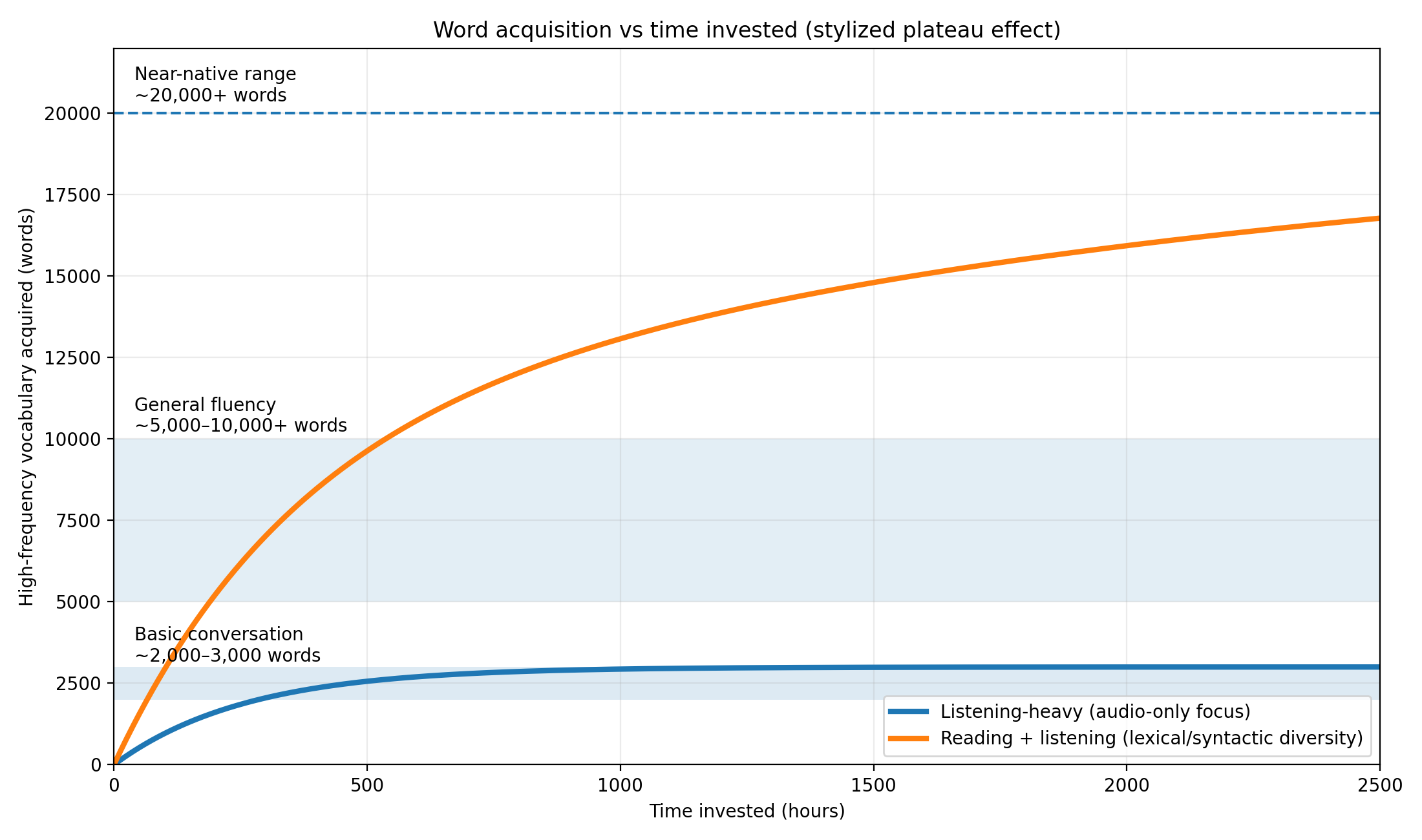
Concretely this means once you have acquired the let say 2000 to 3000 most common spoken words and conversation patterns, the new vocabulary you encounter in casual TV shows or podcasts become increasingly rare. You might watch for hours and only hear one or two truly new and useful words. You're rate of improvement slows down dramatically compared to the amount of time you continue to put in. Your time is mostly spent on reinforcing what you already know rather than efficiently acquiring new knowledge.
As such these learners plateaus relative to time invested. They lack the rich mental model of their target language, which requires vast exposure to lexical and syntactic diversity more readily found in written material. Without exposure to written material which uses more embedded clauses, formal conjunctions, complex sentence architecture, nuanced vocabulary and just more depth, their brain doesn't build the "machinery" to process more sophisticated ideas in the language, limiting the ceiling of what thy can ultimately comprehend.
How reading focused learners compare
The interesting part is that reading-based immersion learners who also did some listening pick up the same skills things but quicker and with much better comprehension and vocabulary, quicker or in a similar amount of time.
Solution: Just read more

"Reading is KING."
— JJ
Reading is a high quality exposure input channel. It allows for precise, slow mapping of words to meaning. It exposes you to wider, more complex, varied and more precise vocabulary and grammar. This foundation you got from reading then enables your listening. When you hear loads of sounds your brain now is matching it against a richer more detailed mental map. You're not just parsing sounds; you are retrieving known words and structures.
This brings us to an important point.
Listening and reading aren't two separate skills. They are two sides of the same coin: comprehension. They complement each other, they go hand in hand to say.
Reading strengthens your mental model: Builds vocabulary, internalizes grammar patterns and creates a detailed mental map of the language.
Listening activates and automates that model. Trains the brain to process and retrieve that map at natural seed under real world conditions.
You can only listen at the start and barely read anything, but it's not wrong or bad if you have your reasons for it but from a learning perspective it's probably not the best approach. Same goes for only reading without and listening.
Starting with ony listening is like trying to assemble a complex puzzle without seeing the picture on the box. Starting with only reading is like studying and observing how the puzzle in the picture might work but never trying to assemble and see how the piece go together quickly.
The optimal path is not sequential, do one thing then another, but mixed, doing reading and listening.
Key Takeaways
- "Reading is king": It's a good idea to make your immersion early on more reading-heavy so you can quickly learn more of the language more efficiently like learn more vocab better so you can get the most out of your listening as well. Try a split that is more tilted towards reading than listening as in 65-70% is reading while 30-35% is listening. It's important to combine reading with listening early on to develop well-rounded skills.
- You are your own guide, use the freedom of immersion to tailor your own experience to your interests while being mindful of the efficiency trade offs i.e choosing something that interests you and is appropriate for the level you're at.